
Organic growth agency for B2B SaaS. Compounding pipeline, not rented traffic.
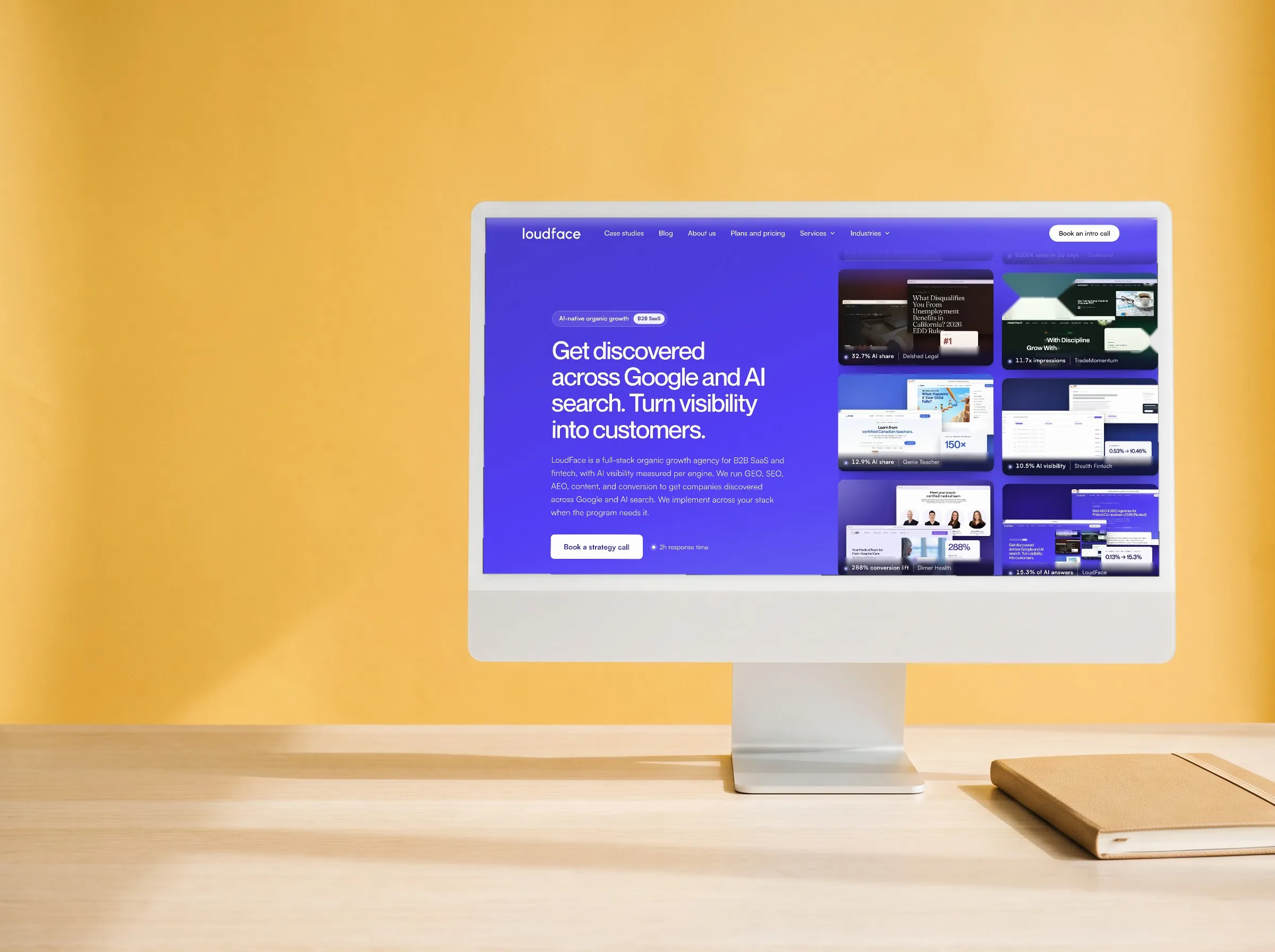
One senior team runs SEO, AEO and GEO, content, and CRO as a single organic growth program. We ran the same playbook on our own site: 0.13% of non-branded AI answers in April 2026, 21.5% over 18 to 28 September 2026 (ChatGPT 38.8%, Google AI Overviews 14.3%, Perplexity 11.2%), on the 141 non-branded prompts we track after a 17 September prompt cut that lifts the reading.
 Genie Teacher
TRUSTED BY
Compounding organic programs for B2B SaaS teams








What’s inside the organic growth program.
Four delivery tracks plus the measurement layer, run by one team on one roadmap: search visibility to bring the visit, content built to be cited, and conversion work to turn attention into pipeline.
SEO and AEO/GEO run as one motion: technical foundation, entity coverage, structured data, and pages engineered to be cited by ChatGPT, Perplexity, and Google AI Overviews as well as ranked by Google.


Topical clusters, comparison pages, FAQ compilations, and first-party research shipped weekly. Written to be quoted: a model should be able to lift the answer straight from the page.
The layer built to turn visits into pipeline: pricing pages buyers can act on, versus pages that clarify honestly, demo paths without friction, and testing that compounds page by page.
Guest placements, G2 and Capterra presence, community and Reddit strategy, and the cross-platform entity signals that make every surface describe the same brand.
Share of answer tracked daily on ChatGPT, Perplexity, and Google AI Overviews, Search Console for organic, first-touch attribution for pipeline. Reported weekly against the roadmap.

Growth you keep, on channels you own.
Paid stops the day the budget stops. An organic program keeps compounding: every cited page makes the next citation easier, and every ranking feeds the next one.

Delshad Legal Google clicks a week outside the celebrity-case pages
Genie Teacher grew Google impressions a day 370×
Google impressions per day, May 2026 average → 7 days to 16 Oct 2026

TradeMomentum grew Google clicks a week 9.1x
Google clicks per week, week of 1 Sep 2025 → week of 21 Sep 2026, its highest week
LoudFace grew its share of non-branded AI answers 0.13% → 21.5%
AI visibility on non-branded prompts, Apr 2026 → 18–28 Sep 2026, after the 17 Sep prompt cut (Peec AI)
Four tracks, one roadmap.
Three to five measurable goals across the four tracks, with a shared scoreboard and clear ownership. The same window we used to measure the program on our own site.
How the organic growth program runs.
No ticket queues and no monthly recommendation decks. We own the roadmap, ship the work, and walk you through the numbers every week.
 LoudFace
Where you stand on Google, inside AI answers, and on conversion, mapped in the first week while the first fixes and calibration articles are already shipping. Technical health, entity coverage, content gaps, and funnel leaks, each scored by pipeline impact so the roadmap starts where the money is.
Three to five measurable goals across the four tracks, with a shared scoreboard and clear ownership. The same window we used to measure the program on our own site.
Content, technical fixes, structured data, conversion tests, and distribution, shipped every week by one team. One point of contact, and the task management stays on our side.
A live walkthrough of what shipped and what moved: share of answer, rankings, conversion, pipeline. Tied to the goals on the roadmap rather than a vanity dashboard.
Organic growth vs performance marketing: which do you need?
Different jobs, different cost curves. The honest answer for most B2B SaaS is a sequence, and the order matters.
| Approach | What it optimizes for | What happens when you stop paying |
|---|---|---|
| Performance marketing | Immediate demand capture: paid search, paid social, retargeting against in-market buyers in ever-pricier auctions | Traffic stops with the budget. The traffic does not carry over. |
| Organic growth | Durable visibility: rankings, AI citations, content assets, and conversion paths that keep working | The assets stay yours. Citations and rankings can keep compounding rather than resetting to zero. |
| Both together | Paid captures demand this quarter while organic builds the channel that lowers blended CAC | Paid spend can taper as organic pipeline grows. The mix shifts while the assets keep working. |
Common questions about the organic growth program.
What is an organic growth agency?
What is the difference between organic growth and performance marketing?
What does the program include?
How is this different from hiring an SEO agency?
How long until organic growth shows results?
How much does an organic growth agency cost?
Should we stop running paid ads?
Who is the program for?
How do you measure organic growth?
Why one team instead of separate agencies?
In their words, with
the numbers

“You guys are the experts. I can rely on you to drive the plan, and I’m probably going to say yes to almost everything.”
 Kenneth O’FrielCEO, Toku
“LoudFace really stood out with their approach and let’s get this done attitude.”
Genie Teacher“Working with LoudFace has been refreshing; we were surprised by their passion.”
One program, four disciplines.
SEO, AEO/GEO, content, and CRO compound fastest when the same team runs them on one roadmap. That is the whole thesis of this program, and it is how we run our own site.




Find out what organic growth could look like for your brand.
We’ll check where you stand on Google and across ChatGPT, Perplexity, and Google AI Overviews, and show you exactly where the gaps are.