The client
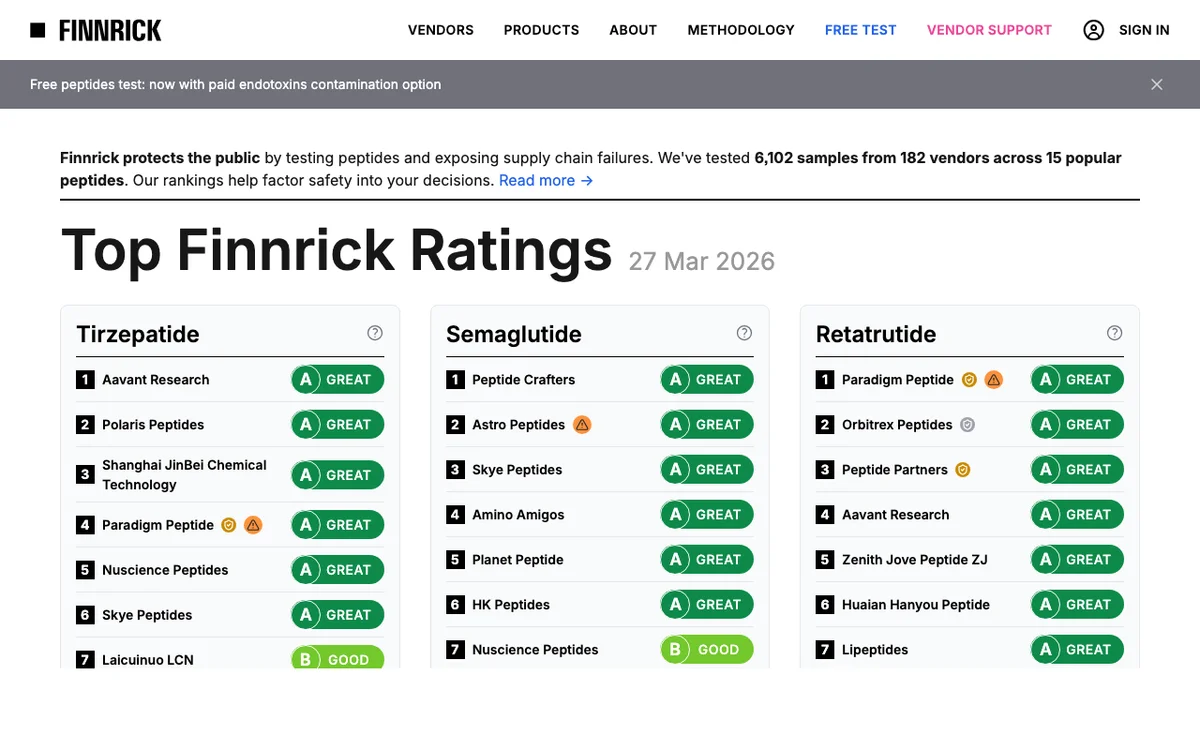
Finnrick Analytics runs the largest independent peptide testing platform in the world. Founded by Raphaël Mazoyer, Finnrick has tested over 6,000 samples from 182 vendors across 15 popular peptides. Every test result is public, every methodology is transparent, and Raphaël discloses every revenue stream.
Gray-market peptides are flooding biohacking and longevity communities. People inject these products into their bodies, often with no independent test data to go on. Finnrick is the only entity doing crowd-sourced, independent safety testing at scale.
When LoudFace started working with them in January 2026, organic search was not a meaningful channel for the business.
The problem
Finnrick had a data-rich product and a growing reputation within niche Reddit and X communities. What they didn't have:
- Organic search traffic that matched the product's authority. The site was getting some baseline visits but had no strategy driving it.
- Content infrastructure. No blog, no editorial strategy, no structured content targeting the questions their audience was searching.
- AI visibility. A clean ChatGPT install did not recommend Finnrick for product safety concerns. Raphaël called that "a core problem we want to solve."
- A way to turn raw testing data into stories that journalists and AI systems would pick up and cite.
The site was technically solid (custom Next.js/Vercel stack) but invisible to the search ecosystem that mattered.
The strategy
LoudFace designed a dual-track SEO/AEO program built around one principle: every piece of content must earn trust, not just traffic.
Raphaël was clear from the start: Finnrick sells trust infrastructure. If the content reads like marketing, it undermines the product. Volume was never the play. Precision was.
LoudFace's copywriter Andrea Van Wyk worked directly with Raphaël on every article. Each piece went through multiple rounds where Raphaël personally vetted every claim, every data point, every word. If he couldn't put his name behind it, it didn't go up.
Andrej Vidovic led the search strategy. He chose which keywords to target, mapped the content gaps, and structured each piece so it worked for both human readers and AI crawlers.
The results
Q1 2026: January 1 – March 31
What LoudFace added to Finnrick's organic channel in 90 days:
Overall growth (Jan → Mar 2026)
| Metric | January | March | Change |
|---|---|---|---|
| Monthly Clicks | 34,148 | 53,243 | +55.9% |
| Monthly Impressions | 603,808 | 968,437 | +60.4% |
| Avg Daily Clicks | ~1,101 | ~1,717 | +56% (+616/day) |
| Average CTR | 5.66% | 5.45% | Stable through growth |
| Average Position | 7.3 | 6.6 | +0.7 improvement |
Page-by-page growth (Jan → Mar)
The gains compounded across every key page on the site:
| Page | Jan Clicks | Mar Clicks | Growth |
|---|---|---|---|
| Homepage | 15,870 | 24,677 | +55.5% |
| Vendors page | 2,380 | 4,636 | +94.8% |
| Retatrutide product page | 1,711 | 2,315 | +35.3% |
| Products listing | 1,289 | 1,813 | +40.7% |
Brand awareness we drove
Branded searches for "finnrick" grew +72.4% in a single month (5,968 → 10,291 clicks, Feb → Mar). That's +4,323 new branded clicks per month.
This is where the SEO and AEO tracks connect. When someone asks ChatGPT about peptide testing and Finnrick comes up in the answer, they don't click a link inside the AI response. They open Google and type "finnrick." That branded search spike in GSC is partly an AI search effect showing up in traditional search data. The user journey goes: AI engine mentions Finnrick → user searches the brand on Google → GSC logs it as a branded click. Strip out the AI visibility work we did and a meaningful share of that +72% branded growth doesn't happen.
The press coverage follows the same pattern. Someone reads about Finnrick in MIT Technology Review, then searches the name on Google. Both channels feed branded search, and both channels are direct results of the content program we built.
Category rankings we built
Before our engagement, Finnrick didn't rank for category search terms. We built these positions from scratch:
| Query | Clicks | CTR | Position |
|---|---|---|---|
| peptide testing | 894 | 20.1% | 6.1 |
| peptide testing labs | 779 | 22.1% | 4.0 |
| free peptide testing | 533 | 50.1% | 2.1 |
| peptide testing companies | 82 | 19.2% | 3.0 |
| 3rd party peptide testing | 80 | 14.0% | 5.0 |
Competitor capture — an entirely new channel
We created a vendor page strategy that didn't exist before. Finnrick now ranks for 10+ competitor brand names, pulling in 5,000+ new clicks per quarter from people who were searching for competitors and found Finnrick instead:
| Vendor Query | Clicks | Position |
|---|---|---|
| atomik labz | 1,162 | 3.5 |
| wwb peptides | 945 | 4.7 |
| aavant research | 570 | 3.5 |
| peptide partners | 530 | 3.7 |
| nexaph | 472 | 3.9 |
| eternal peptides | 447 | 4.8 |
Press coverage we earned
MIT Technology Review's February 2026 peptides piece cited Finnrick's Endotoxins testing data directly. BBC and The Guardian picked it up too. None of these citations existed before our engagement. No outreach to journalists, no paid placements. The content was good enough that reporters found it on their own.
AI visibility we built
Try asking ChatGPT "where can I get peptides tested independently?" Finnrick comes up. Same on Perplexity, Gemini, and Claude. Before our engagement, none of them mentioned Finnrick.
We track 30 AI search prompts via Peec AI. Finnrick is the #1 cited result on 17 of them (57%). These aren't obscure queries. They're the exact questions Finnrick's customers are asking AI engines:
| AI Prompt | Position |
|---|---|
| Where can researchers find publicly available peptide vendor scorecards? | #1 |
| Which BPC-157 vendors have passed independent lab testing? | #1 |
| Are there any independent safety platforms for the peptide market? | #1 |
| Where can I find independent third-party testing data on peptide suppliers? | #1 |
| Are there any databases that rank peptide vendors by quality? | #1 |
| What are the most reliable sources for peptide vendor reviews? | #1 |
The remaining 13 prompts don't yet surface Finnrick. That's the Q2 roadmap.
We built this visibility through entity-first content architecture, structured data, and an LLMs.txt file that tells crawlers exactly what Finnrick is and does.
What made this different
Most SEO case studies are about ranking for keywords. This one is about something harder: building trust in a market where people are injecting gray-market products into their bodies and relying on strangers on Reddit for safety information.
We didn't write SEO content that happens to be about peptide testing. We wrote peptide safety content that happens to rank. The distinction matters. MIT Technology Review didn't cite Finnrick because of our meta descriptions. They cited it because the Endotoxins article contained original test data that no one else had published.
Raphaël made this possible by being difficult to work with (in the best way). He vetted every claim, killed anything that felt like marketing, and pushed our writers to match his standard. Most clients approve drafts quickly. Raphaël sent them back with corrections.
And the AEO track is worth calling out specifically. Most agencies bolt AI search onto an existing SEO program as an upsell. We built the content architecture from day one so AI engines could parse, understand, and cite it. Entity-first writing, structured answers, LLMs.txt. That's why Finnrick shows up in ChatGPT and Perplexity, not just Google.
"The first one you did on Endotoxins got us covered in the MIT Tech Review and the BBC and the Guardian."
— Raphaël Mazoyer, CEO, Finnrick Analytics
Engagement: Ongoing since January 2026 · SEO/AEO Growth Partnership · finnrick.com