

 The short answerMicrosoft Copilot answers with large language models grounded in the public web and, with a paid Microsoft 365 Copilot license, your work data through Microsoft Graph. When the web would help, the work version sends Bing a few-word query and answers with linked citations. IT admins can turn web search off for users or user groups across the tenant.
Microsoft Copilot answers with large language models grounded in two places: the public web and, with a paid Microsoft 365 Copilot license, your work data through Microsoft Graph. When the web would improve an answer, the work version turns your prompt into a few-word search query, sends it to Bing, and replies from the results, with linked citations.
At a glance:
- Copilot searches only when it judges that the web would improve the answer, and a company's IT admin can switch web search off for users or user groups across the tenant.
- The work version of Copilot sends Bing a short query it writes itself. Your whole prompt (unless it is very short), your files and your Microsoft Entra identity stay out of it.
- Answers grounded in the web link to the pages they used. Per Microsoft Learn, Copilot Chat shows the exact queries it sent to Bing, and only for 24 hours.
- A page can only be cited if Bing returns it for that short query, so Bing indexing and fresh, self-contained answers are the levers a brand controls.
Method: we read Microsoft Learn, Microsoft Support and the Bing blogs on 24 November 2026, and pulled Bing's results for "how does copilot work" the same day through DataForSEO. Every quote below names the page it comes from.
How Copilot answers a question, in four steps
| Step | What happens | What it means for your brand |
|---|---|---|
| 1. It screens the prompt | Microsoft's consumer transparency note says the prompt, conversation history and system message go "through several input classifiers," then Copilot decides whether the request "requires grounding data from the web and which language model should respond." | You can't influence this step with anything you publish. |
| 2. It decides whether to search | Microsoft Learn says the work versions "may fetch information from the Bing search service when information from the web helps to provide a better, more grounded response." | If the model thinks it can answer alone, no page gets read, yours included. |
| 3. It writes a short query | In the work versions, Copilot "generates a search query" that "consists of a few words informed by the user's prompt" and sends it to Bing. | You compete for the short query Copilot writes, which is rarely the sentence the buyer typed. |
| 4. It answers and cites | Web-grounded answers carry "hyperlinked citations listed below the text," per the consumer note. Copilot Chat also lists the exact queries it sent to Bing. | The pages Bing returns for that query are the pages Copilot can cite. |
Gemini, Claude, Perplexity and ChatGPT each search and cite their own way. Our explainers on how Gemini works, how Claude works, how Perplexity works and where ChatGPT gets its information cover each one, and our roundup of AI search engines compares them side by side.
Which Copilot are we talking about?
Three products share the name, and Microsoft renamed two of them in 2026. Each claim below says which one it covers.
| Product (name as of November 2026) | Earlier name | What Microsoft says it grounds answers in | How it shows sources |
|---|---|---|---|
| Copilot for personal accounts ("Microsoft Copilot (for individuals)") | Bing Chat | "web search results" for "certain conversations where users seek information" | Hyperlinked citations below the text |
| Microsoft Copilot Chat, on the Basic license that comes with eligible Microsoft 365 plans | Microsoft 365 Copilot Chat | "web data only," plus any file a user adds to the prompt | Web search query citations in Copilot Chat |
| Microsoft Copilot, on the paid Premium license | Microsoft 365 Copilot | "web data and work data (Microsoft Graph and Work IQ)" | Citations in Copilot Chat; none in the Copilot pane inside Word or PowerPoint |
The history explains the Bing link. At Ignite on November 15, 2023, Microsoft wrote that "Bing Chat and Bing Chat Enterprise will now simply become Copilot," and the product kept its Bing roots. Microsoft Support says the Microsoft 365 app began rolling out under the name "Microsoft 365 Copilot" on January 15, 2025. A Message Center post, MC1454108, published August 13, 2026, said "The Microsoft 365 Copilot app will adopt a simpler name," rolling out from mid-August 2026 on web and mobile and from mid-September 2026 on Windows and Mac. Microsoft Learn, last updated November 17, 2026, now says "The Microsoft 365 Copilot app is now called Microsoft Copilot," and the license names stayed as they were: your IT team still buys "Microsoft 365 Copilot (Premium)."
GitHub Copilot, Microsoft Security Copilot and Microsoft Copilot Studio are separate products that Microsoft Learn says "are independently licensed." Nothing here covers them.
How does Copilot produce an answer?
It runs your prompt through a language model and, when it helps, feeds that model outside sources first. Microsoft calls the feeding step grounding: "the process of providing input sources to the LLM related to the prompt," using "data from Microsoft Graph or Bing."
The models. For the work product, Microsoft's application card says Copilot "uses a combination of LLMs," including "models provided by Microsoft (Azure OpenAI Service), Anthropic, and OpenAI," among them "Claude Opus and Claude Sonnet models" and "GPT models." Microsoft Learn's Copilot overview adds that by default "Copilot uses a real-time router" to pick the model for each prompt, with Auto, Quick response and Think deeper modes. The consumer transparency note is vaguer: it says the personal app uses "language and multi-modal models from Microsoft, OpenAI, and other model developers" and names no specific model, so don't assume it runs the same lineup.
The work pipeline. The prompt "can include text from input files or other content discovered by Microsoft Copilot using Microsoft Graph." Copilot sends it to the model, then post-processes the reply with "other grounding calls to Microsoft Graph, responsible AI checks such as content classifiers, security, compliance and privacy checks, and command generation."
Sometimes it retrieves nothing. Microsoft's card says Copilot "doesn't require web content or organizational data to provide a response." In that case it "relies only on its LLMs," so an answer about your company can come straight from what the model already holds, with no link to you anywhere.
When does Copilot search the web?
When it decides the web would make the answer better. Microsoft Learn's page on web search, last updated November 3, 2026, describes the trigger for both work products: Copilot reads the prompt and "identifies terms where information from the web would improve the quality of the response." From those terms it builds a query for Bing.
Microsoft gives three worked examples on the same page:
- "I'm looking for a document authored last week by [coworker]." No search. "No web search queries are generated."
- A prompt about a Fabrikam acquisition. Copilot generated two queries, "Fabrikam strategy" and "Fabrikam financials," and answered in two sections headed "From your company's data" and "From the web."
- A question about a coworker's internal decision. Copilot leaves the web out, because in Microsoft's words "there's no relevant information available on the web."
Our read: questions about a buyer's own files stay inside the company, and questions about markets, vendors and categories reach Bing. A buyer asking Copilot to compare vendors in your category is asking the second kind.
The personal app follows the same idea in looser words. Its transparency note says Copilot "can perform web searches and will use the top web search results to generate a summary." That note doesn't name Bing. Microsoft Advertising does: "Powered by Bing's search index, experiences like Microsoft Copilot, Microsoft Start, and others handle billions of queries each month."
What does Copilot send to Bing?
A few words, plus your IP address. For Microsoft Copilot and Copilot Chat, Microsoft Learn says the generated query "is different from the user's original prompt" and "consists of a few words informed by the user's prompt."
What stays out, in Microsoft's words:
- "The user's entire prompt, unless the prompt is very short"
- "Entire Microsoft 365 files (for example, emails or documents) or files uploaded into Copilot"
- "Any identifying information based on the user's Microsoft Entra ID (for example, username, domain, or tenant ID)"
What goes along: "the user's client IP address, which Bing uses to help localize results."
An open document can still shape the query. In Microsoft's example, Copilot reads an internal clean-energy strategy and sends Bing "Fabrikam clean energy policy announcements." Microsoft adds that "the document itself isn't included."
How Bing treats those queries matters to anyone selling to regulated buyers. Per Microsoft Learn, the queries don't change Bing's search ranking, never go to advertisers and don't train generative AI foundation models. Bing runs separately from Microsoft 365 under its own data handling, with Microsoft as the data controller for the query data. The line for your compliance team: "HIPAA compliance and the EU Data Boundary don't apply to generated search queries."
The gap between what a buyer types and what the engine searches is the same one our fan-out queries explainer covers for tracked AI prompts. Microsoft documents these query details for the work products only. Its consumer note doesn't say how the personal app builds its queries.
How does Copilot choose what to cite?
From what Bing returns, broken into pieces. Microsoft's consumer note says that for some questions "Copilot centers its response on high-ranking content from the web and provides hyperlinked citations." On the work side, Copilot Chat goes further and "shows the exact web search queries (derived from the user's prompt) that were sent to the Bing search service." Two limits apply: "Citations aren't available in the Copilot pane within a Microsoft 365 app, such as Word or PowerPoint," and the queries "are only available in the chat thread for 24 hours."
Microsoft has described, in general terms, how it picks pieces of pages. A Microsoft Advertising post from October 2025 says "Assistants like Copilot break content down, a process called parsing, into smaller, structured pieces that can be evaluated for authority and relevance." Its advice: "Make answers snippable: Use concise, self-contained phrasing in lists, Q&As, and tables." The same post admits "there's no secret sauce that guarantees selection in AI answers."
Bing's search team put the shift plainly on May 6, 2026: "Traditional search asks: which pages should a user visit? Grounding asks: what information can an AI system responsibly use to construct a response?" The unit that wins is "discrete, supportable facts with clear provenance." And when the support is weak, the answer may cite nobody: "Abstention is a valid outcome when support is missing, stale, or conflicting."
Microsoft also makes a bigger claim. In February 2026 Jordi Ribas, Corporate Vice President for Search and AI, wrote that "Microsoft grounding powers nearly every major AI assistant in the market." He named no assistants, so treat it as Microsoft's claim, not a measured fact.
One thing we saw for ourselves: on 24 November 2026, 7 of Bing's top 10 results for "how does copilot work" were Microsoft-owned pages (DataForSEO Bing pull). On a question about a vendor's own product, expect the vendor's pages to fill the pool Copilot cites from. On questions about your category, the pool is whoever Bing ranks, and that is where you can win.
Can your IT admin turn Copilot web search off?
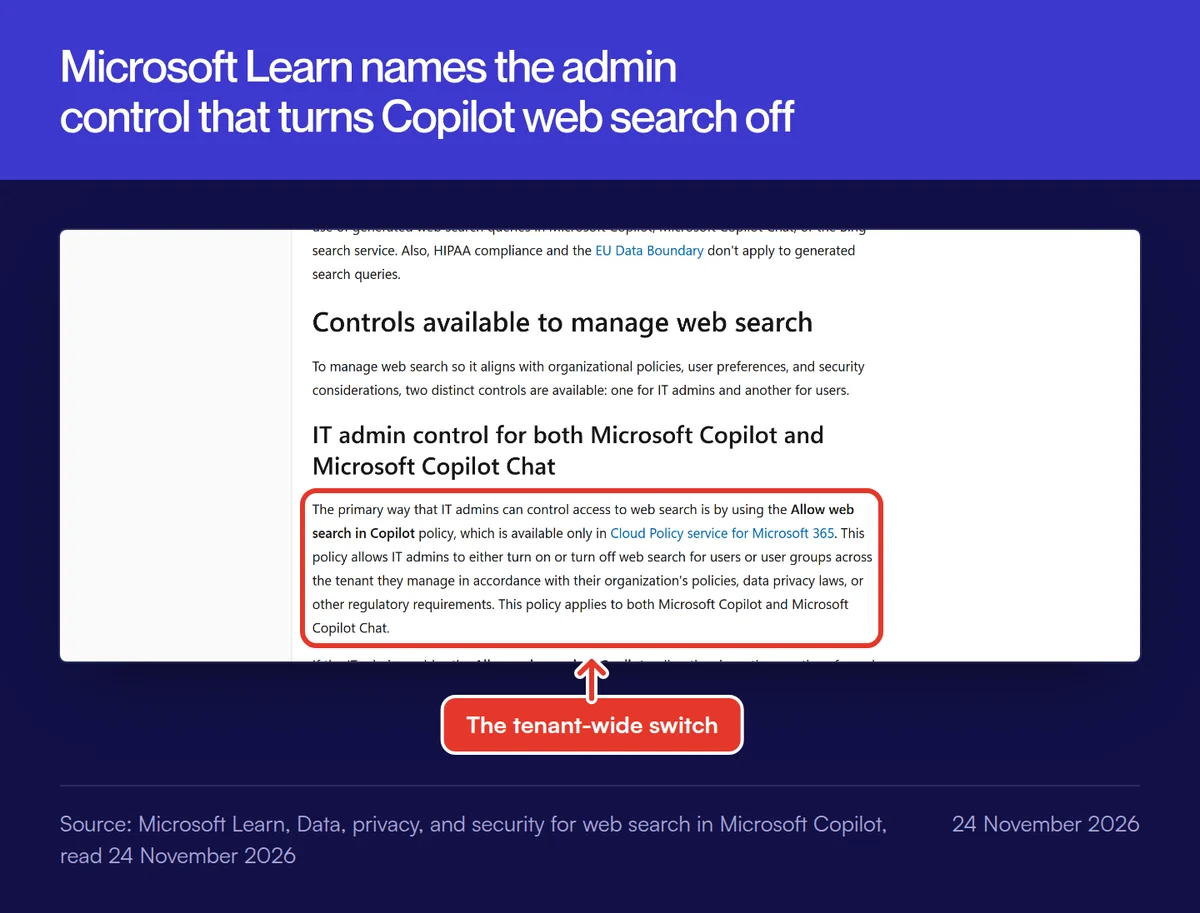
Yes, for everyone or for chosen groups. Microsoft Learn says IT admins can turn web search on or off "for users or user groups across the tenant they manage." It names the control "the Allow web search in Copilot policy, which is available only in Cloud Policy service for Microsoft 365." It "applies to both Microsoft Copilot and Microsoft Copilot Chat" and has three settings:
| Setting | Microsoft Copilot | Microsoft Copilot Chat |
|---|---|---|
| "Enabled in Microsoft Copilot and Microsoft Copilot Chat" | Web on | Web on |
| "Disabled in Microsoft Copilot and Microsoft Copilot Chat" | Web off | Web off |
| "Disabled in Microsoft Copilot Work mode; Enabled in Microsoft Copilot Web mode and Microsoft Copilot Chat" | Off in Work mode, on in Web mode | Web on |
The default depends on the cloud. For commercial tenants, Microsoft Learn says: "If the IT admin doesn't configure the Allow web search in Copilot policy, web search will be available to users in both Microsoft Copilot and Microsoft Copilot Chat," unless the admin has disabled "the Allow the use of additional optional connected experiences in Office policy." For US government customers on GCC or DoD, "Web search is available, but is turned off by default," and it stays off while the policy is unset.
Users get a switch too. "If the IT admin enables web search, the Web content toggle is turned on by default." If a user turns it off, "web content isn't included in Copilot responses." Admins can also search, audit and run eDiscovery on "the exact web search queries Copilot derived from the user's prompt."
If you sell to enterprises or government, take this seriously. When an admin switches web grounding off for users or user groups across the tenant with the Allow web search in Copilot policy, or a user turns off the Web content toggle, some B2B buyers' Copilot never reads the web: work-data answers then come only from the model and, on a Premium license, from Microsoft Graph. No page of yours reaches those buyers through Copilot, however well it ranks in Bing.
Does Copilot read your company's files?
Only with the right license, and only what you can already open. Microsoft Learn says the Premium license grounds answers in "organizational data (emails, files, meetings, calendars, teams, or organizational relationships) through Microsoft Graph, Work IQ, Copilot Search, and semantic indexing." On the Basic tiers, "Copilot Chat can use organizational content, but you must explicitly provide that content with your prompt," and those users "don't have access to Microsoft Graph."
Three rules from Microsoft's privacy page and web search page cover the rest:
- "Microsoft Copilot only surfaces organizational data to which individual users have at least view permissions."
- "Prompts, responses, and data accessed through Microsoft Graph aren't used to train foundation LLMs."
- Prompts and responses "are stored within Microsoft 365 and never leave the service boundary" for Microsoft Copilot and Copilot Chat "without customer direction."
For a B2B SaaS company, that means a buyer's Copilot can blend your public pages with their internal notes about you in one answer, under headings like "From your company's data" and "From the web." You only influence the second half.
How does a B2B SaaS get cited in Microsoft Copilot?
By being the page Bing returns for the short query Copilot writes, with a fact Copilot can lift in one piece. We don't track Copilot in our own reporting, so what follows rests on Microsoft's documentation plus what we see in the engines we do track.
The pattern from our tracking carries over. In a Peec sample of 120 answers from ChatGPT, Perplexity and Google AI Overviews (40 per engine, 26 August to 1 September 2026), every answer that named LoudFace had a loudface.co page in its sources. That is not Copilot data. The Copilot version of the rule follows from Microsoft's docs: your page has to be in what Bing returns for Copilot's few-word query.
1. Get into Bing's index and check it. Copilot's web layer is Bing's index, so verify your site in Bing Webmaster Tools and fix what it reports. A page Bing hasn't indexed can't be grounded on.
2. Tell Bing when a page changes. IndexNow pings search engines the moment a URL is added, updated or deleted, and IndexNow.org lists support from Microsoft Bing, Naver, Seznam.cz, Yandex and Yep. Bing ties freshness to AI answers directly. In a post on February 10, 2026, Bing said "Accurate and up to date content is important for inclusion and citation in AI-generated answers." Keep lastmod in your sitemap honest too. Bing's sitemap post from July 31, 2025 calls lastmod a key signal for recrawling and says Bing ignores the changefreq and priority tags. The same post concedes that no tool can promise when or how a page shows up in AI answers.
3. Write answers that survive being cut out. Bing's advice: "Clear headings, tables, and FAQ sections help surface key information." Put a direct answer under each question-shaped heading. Our guide to structuring content for AI extraction covers the format.
4. Keep your facts current. Bing says "In grounding, a stale fact produces a misleading response." Old pricing or a retired product name on a live page is the fact Copilot will repeat. Our guide on fixing stale AI facts walks through finding them.
5. Don't opt out by accident. In a September 22, 2023 post written for Bing Chat, Bing said "Content tagged NOARCHIVE will not be included in Bing Chat answers," and with NOCACHE "We will only display URL/Snippet/Title in the answer." No 2026 Microsoft page we read restates those tags for Copilot. Bing's 2026 post does say it "respects all content owner preferences expressed through robots.txt and other supported control mechanisms." Audit both before you assume Copilot ignores you.
6. Measure Copilot on its own. Bing Webmaster Tools added an AI Performance report in public preview on February 10, 2026. It "shows how publisher content appears across Microsoft Copilot, AI-generated summaries in Bing, and select partner integrations," with Total Citations, Average Cited Pages and Grounding queries, the phrases "the AI used when retrieving content." Bing added Citation Share on June 16, 2026, the share of citations your site gets "out of all citations shown across all sites for that same grounding query." It "does not expose competitor domains." If an agency reports AI visibility to you, ask whether Copilot is in it; our list of AI search agencies that measure citations shows who reports per engine.
Being cited in Copilot means Bing has indexed your page and returns it for the short generated queries Copilot sends, so we hold our own site to the first two steps. On loudface.co we ping IndexNow every time a post ships, and our robots.txt allows search, ai-input and ai-train for every crawler.
LoudFace runs this work for B2B SaaS teams through its generative engine optimization service. The free AI visibility audit shows where your brand stands against competitors in ChatGPT, Claude, Gemini and Perplexity.
How reliable are Copilot's answers?
Check the citation before you repeat a number. Both of Microsoft's transparency notes carry the same warning: "Even when drawing responses from high-authority web data, responses might misrepresent that content in a way that might not be completely accurate, up to date, or reliable." The consumer note adds that Copilot may "fabricate content that might sound reasonable but is factually inaccurate."
That cuts both ways for a brand. A buyer can get a wrong fact about you with your own page linked underneath it. The fix sits on your page: one clear, current, sourced statement of the fact, where Bing can find it.