

 The short answerAI engines rarely cite case studies for shortlists and do cite them for proof. On 68 B2B software shortlist questions no engine cited one; on 18 proof-seeking questions ChatGPT cited one in 17 answers, Perplexity in 14, Google AI Overviews in 16. On agency questions, excluding loudface.co, case studies took 7.11%, 4.63% and 0.29% of citations.
When an engine does cite an agency's case study, the answer names that agency 96.9% of the time on ChatGPT, 99.0% on Perplexity and 19 of 19 times on Google AI Overviews.
That matters if you run marketing at a B2B SaaS company and you are deciding how much to put into customer stories. A case study will not get you onto the list a buyer asks for. It is the page an engine reaches for once the buyer asks "who has actually done this?", and it is the source that comes back with your name attached.
Do AI engines cite case studies?
Yes, at a low rate, and very differently by engine. We read every source ChatGPT, Perplexity and Google AI Overviews showed for the 99 agency-buying questions LoudFace tracks in Peec AI, over 30 complete days (24 October to 22 November 2026). Then we sorted every cited address into case-study pages (a single client story, an owner's case-study index, or a roundup of other people's stories) and everything else.
| Measure | ChatGPT | Perplexity | Google AI Overviews |
|---|---|---|---|
| Case-study pages, share of all citations | 1,285 (7.11%) | 767 (4.63%) | 88 (0.29%) |
| Single client stories, share of all citations | 746 (4.13%) | 433 (2.61%) | 36 (0.12%) |
| Answers citing at least one case-study page | 340 of 2,850 (11.9%) | 129 (4.5%) | 24 (0.8%) |
| Answers that retrieved a case-study page, cited or not | 776 (27.2%) | 168 (5.9%) | 29 (1.0%) |
| Case-study citations per retrieval (all pages) | 0.22 (0.27) | 0.99 (0.42) | 1.07 (1.26) |
Peec AI project for LoudFace, 99 agency-buying questions asked daily, 24 October to 22 November 2026; ChatGPT 18,063, Perplexity 16,563 and Google AI Overviews 30,130 URL citations. Answer counts cover the 95 questions that are not brand questions about LoudFace. loudface.co pages are removed from every count and every total in this table.
ChatGPT cites case studies most, and still cites only a fraction of what it reads. It retrieved a case-study page in 27.2% of answers and cited one in 11.9%.
Perplexity cites what it reads. It cited case-study pages at 0.99 per retrieval, more than double its 0.42 average for all pages.
Google AI Overviews barely touches them on agency questions. 0.29% of its citations went to case-study pages. With 88 citations in 30 days, read Google's agency figures as a direction rather than a measurement. On the proof-seeking software questions below, Google AI Overviews cited a case study in 16 of 18 answers.
Which buyer questions make AI engines cite a case study?
Questions that ask for proof, on both datasets. Split by question type, proof and vendor-named questions cite case studies, and generic "best" shortlist questions cite them far less or never. None of the top Google results on this topic break it down by question type.
Software buying questions. We wrote 45 B2B software buying questions across 9 categories, froze the list before collecting anything, and asked each one once per engine in the US on 23 November 2026. We then re-read the 50 shortlist questions from our software review sites study, collected the same way two days earlier.
| Question type | Example | ChatGPT | Perplexity | Google AI Overviews |
|---|---|---|---|---|
| Shortlist | "best CRM for a 100-person B2B SaaS sales team" | 0/18 | 0/18 | 0/18 |
| Proof-seeking | "which CRM has real customer results for mid-market B2B companies" | 17/18 | 14/18 | 16/18 |
| ... names case studies or customer stories | "which call recording tools have case studies from B2B SaaS companies" | 7/7 | 7/7 | 7/7 |
| ... asks for examples or results without those words | "examples of B2B companies that grew pipeline after switching CRM" | 10/11 | 7/11 | 9/11 |
| A named vendor's results | "what results do companies get from using Gong" | 9/9 | 8/9 | 6/9 |
Answers citing at least one case-study page, out of answers asked. LoudFace sample, US, 23 November 2026, one answer per question per engine.
Pool the 18 new shortlist questions with the 50 older ones and the count is 0 of 68 on every engine (Wilson 95% upper bound 5.3%). Proof-seeking answers are the opposite: the 95% interval runs from 74.2% to 99.0% on ChatGPT, 54.8% to 91.0% on Perplexity and 67.2% to 96.9% on Google AI Overviews.
The buyer does not need to say "case study". Questions asking for examples or results, without those words, drew a case study in 10 of 11 ChatGPT answers, 7 of 11 Perplexity answers and 9 of 11 Google AI Overviews answers.
Agency buying questions. The 99 Peec questions split the same way, at lower levels.
| Question type | Questions | ChatGPT | Perplexity | Google AI Overviews |
|---|---|---|---|---|
| Proof or results ("Which agencies can show before-and-after AI share of voice numbers for a B2B SaaS client?") | 6 | 28.9% | 17.8% | 7.8% |
| Vertical or stage shortlist | 24 | 13.5% | 3.2% | 0.1% |
| Generic shortlist (best, top, recommend) | 49 | 11.7% | 4.1% | 0.4% |
| Pricing | 6 | 10.0% | 5.6% | 1.1% |
| Alternatives or comparison | 8 | 0.4% | 1.7% | 0.4% |
| How-to advice | 2 | 0% | 0% | 0% |
Share of answers citing any case-study page, LoudFace pages excluded. Peec AI, 30 days to 22 November 2026, 30 answers per question per engine.
Proof questions drew case-study citations at about 2.5 times the generic-shortlist rate on ChatGPT, about 4 times on Perplexity and about 20 times on Google AI Overviews. 21 of the 99 questions drew no case-study citation on any engine in 30 days. The single question with the most was "Agencies that have fintech case studies for AI search visibility": 24 of 30 Perplexity answers cited a case-study page, against 7 of 30 on ChatGPT and 7 of 30 on Google AI Overviews.
Agency shortlist answers cited a case study now and then: 11.7% of generic shortlist answers on ChatGPT, 4.1% on Perplexity and 0.4% on Google AI Overviews. Software shortlist answers cited one in 0 of 68 cases on every engine.
Answers citing any case-study page, by question type and engine. Peec AI, 99 LoudFace agency-buying questions, 30 days to 22 November 2026, LoudFace pages excluded.
Does ChatGPT read case studies it doesn't cite?
Yes, far more often than it cites them.
Peec shows the search queries ChatGPT writes for itself before it answers. On the agency questions, 1,772 of its 4,794 visible queries (37.0%) contained "case stud", "customer stor" or "success stor", and 43.0% of its answers ran at least one such search. A typical one: "best SaaS SEO agencies organic traffic growth case studies 2026". Only 18.2% of those answers went on to cite a case study, against 7.2% of answers without such a search.
Perplexity searched for case studies far less (2.7% of answers), but when it did, 70.1% of those answers cited one. Google AI Overviews exposes no queries in Peec, though Google's own documentation says AI Overviews may use a "query fan-out" technique, "issuing multiple related searches across subtopics and data sources".
The same gap shows up in the page counts. Case-study pages were 8.41% of ChatGPT's retrievals and 7.11% of its citations, and ChatGPT cited them at 0.22 per retrieval against 0.27 for all pages. ChatGPT reads widely and cites a short list on every kind of page: across all non-LoudFace sources on these questions it showed 18,063 citations from 68,152 retrievals.
Does a cited case study get its owner named?
Almost always. We took every answer where an agency's case-study page appeared in the sources, and checked whether the answer text named that agency.
| Agency's case-study page in the answer | ChatGPT | Perplexity | Google AI Overviews |
|---|---|---|---|
| Cited | 467/482 (96.9%) | 189/191 (99.0%) | 19/19 |
| Retrieved but not cited | 439/1,176 (37.3%) | 33/67 (49.3%) | 5/6 |
| Same question, same engine, page absent | 2,174/5,880 (37.0%) | 1,044/2,885 (36.2%) | 83/430 (19.3%) |
Answer and agency pairs, Peec AI agency questions, 30 days to 22 November 2026, LoudFace excluded. Google AI Overviews cells are small.
On ChatGPT, an agency whose case study was read and left out was named in 37.3% of answers, level with the 37.0% baseline for that question when its page was absent, and far below the 96.9% when its case study was cited.
This is co-occurrence. Peec does not show whether the engine decided on the name first and then fetched the proof, or the other way round, so a cited case study should not be read as the cause of the mention. What the data does show is that a cited case study and a named owner turn up in the same answer far more often than a retrieved-only page and a named owner do.
Software answers looked similar. Counting each answer and cited vendor as one pair, the vendor whose own customer story was cited was named in 67 of 67 pairs on ChatGPT, 34 of 38 on Perplexity and 29 of 33 on Google AI Overviews.
Owner named when its case study is cited, per engine, against the same question with the page absent. Peec AI agency questions, 30 days to 22 November 2026, LoudFace excluded.
Whose case studies get cited?
The company that did the work, on its own site. For agency questions that means agencies describing their clients. For software questions it means vendors describing their customers.
On the agency questions, agencies and consultants owned 94.2% of the cited single client stories on ChatGPT, 98.6% on Perplexity and 91.7% on Google AI Overviews. Software vendors' customer stories owned 2.8%, 1.4% and 8.3%. On the software questions it flipped: the vendor's own customer story made up 96.4% of ChatGPT's case-study citations, 86.8% of Perplexity's and 67.5% of Google AI Overviews'.
Citations bunch up. Counting loudface.co, 102 owner domains earned at least one story citation on ChatGPT, 45 on Perplexity and 23 on Google AI Overviews, and the top 5 owners held 42.1%, 53.7% and 66.7% of story citations.
We read the most-cited pages before describing them (23 November 2026):
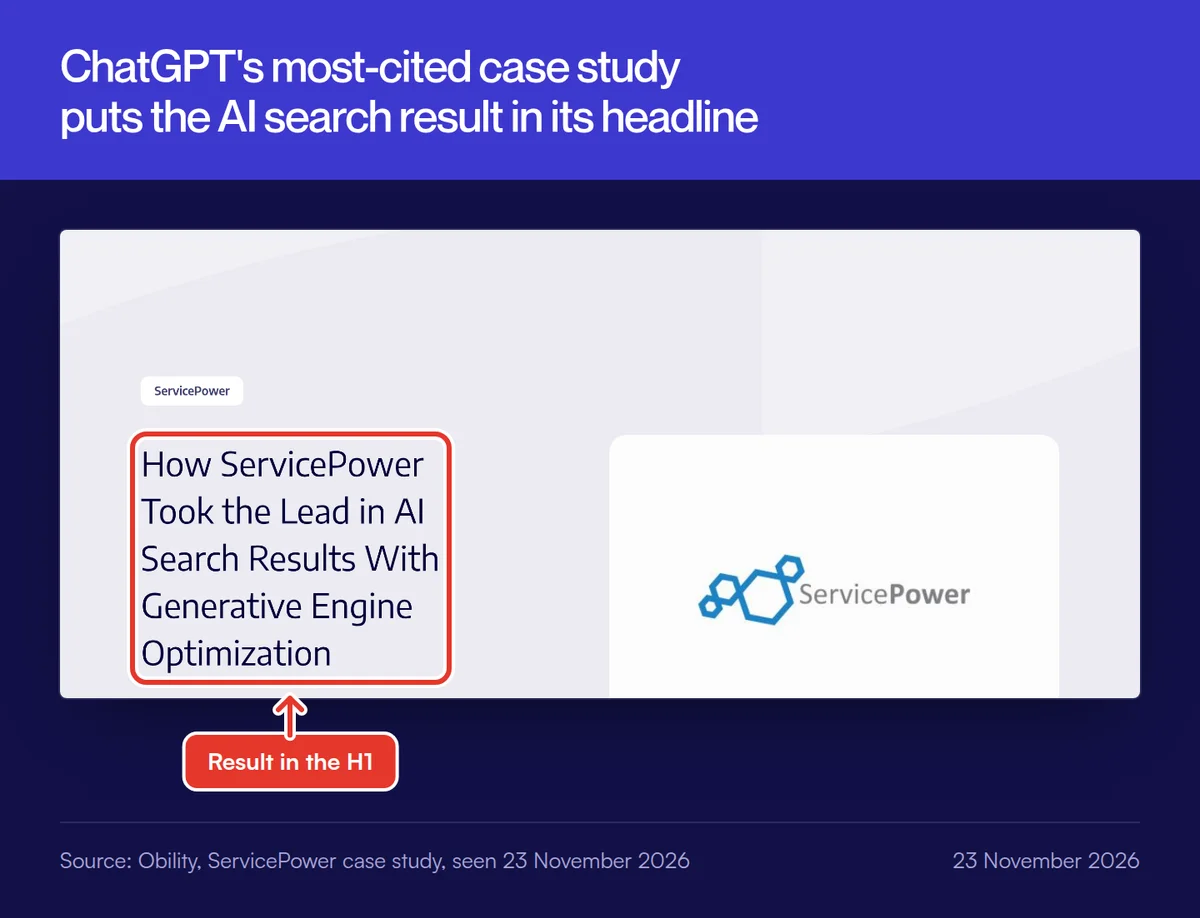
- ChatGPT's most-cited case study was Obility's ServicePower story, with 91 citations from 155 retrievals. Its H1 reads "How ServicePower Took the Lead in AI Search Results With Generative Engine Optimization", and the page says the work began with "a visibility audit across platforms like ChatGPT, Perplexity, and Google's AI Overviews".
- Perplexity's most-cited case study was Omniscient Digital's Convert story, titled "Convert Grows LLM Visibility 81% and AI Citations 140% in 60 days" (Perplexity 49 citations from 19 retrievals, ChatGPT 35 from 36).
- Marcel Digital's B2B SaaS story (ChatGPT 43 citations from 111 retrievals) is laid out as The Challenge, The Analysis, The Solution, The Results.
- Bayleaf Digital's HR tech story (ChatGPT 28 from 52) puts its result in the H1: "GEO Program Lifted AI Brand Visibility from 11.14% to 24% and Grew Citations 5.9x for an HR Tech SaaS".
- Google AI Overviews' most-cited non-LoudFace story was the Grow and Convert story "How We Doubled AI Visibility for a B2B SaaS Client in 9 Months", with 4 citations.
- On the software questions, cited stories included the HubSpot customer story "ResellerRatings Increases New Customer Growth by 60% With the Help of the HubSpot CRM Platform" and the Churned story "How Uptrends, part of ITRS Group, Reduced Churn by 20% with Churned".
Are case-study index pages or single stories cited more?
Both earn citations; roundups of other companies' stories barely do. With LoudFace excluded, case-study index pages (an owner's list of its own stories) took 489 citations on ChatGPT, 303 on Perplexity and 30 on Google AI Overviews, against 746, 433 and 36 for single stories.
Per retrieval, the index page did slightly better on ChatGPT (0.28 against 0.20 for single stories) and about the same on Perplexity (1.07 against 1.00). The most-cited case-study address of any kind was Omniscient Digital's index page, headed "Results we've driven for clients", with 160 citations on ChatGPT and 102 on Perplexity. It lists 15 client cards, and 14 of them state a result with a number, such as the Convert card's "Grew LLM visibility 81% and AI citations 140%".
Roundups that collect several companies' case studies took 50 citations on ChatGPT (0.28%), 31 on Perplexity (0.19%) and 22 on Google AI Overviews (0.07%). ChatGPT and Perplexity go to the owner's own page far more than to lists of other people's results. Google AI Overviews leans on roundups more: they took 22 of its 88 case-study citations.
What do the cited case studies have in common?
Three things stand out, and one of them depends on the engine.
They match the question's topic. Stories whose title or address names AI search took 70.4% of ChatGPT's story citations, 54.7% of Perplexity's and 80.6% of Google AI Overviews'. The questions were about AI search agencies, so this says the engines pick proof that matches the buyer's problem. It does not show that AI-search stories win in general.
A number in the title helps on Perplexity. Stories with a number in the title were cited 1.26 times per retrieval on Perplexity, against 0.59 for stories without one. On ChatGPT the rates were equal (0.20 and 0.20). Google AI Overviews had 27 and 9 citations, too few to compare.
They follow the familiar structure. Every top Google page on writing case studies describes the same anatomy: the challenge, what was done, the results, with concrete numbers. The cited pages we read for this study follow it too, and most of them put the headline result in the title.
None of this is a ranking factor anyone has published. OpenAI says "ChatGPT ranks search results using multiple factors intended to help users find relevant, reliable information. Placement is not guaranteed." Google says "There are no additional requirements to appear in AI Overviews or AI Mode, nor other special optimizations necessary." Google's helpful-content guidance does ask whether your content shows first-hand expertise, "Does your content clearly demonstrate first-hand expertise and a depth of knowledge". A case study is first-hand evidence by nature; tying that to AI citations is our own reading, and Google does not make that link.
What buyers and marketers say about case studies
Surveys measure attitudes; our data measures citations. Read each against its own question.
- Marketers rank customer stories third for trust. In the Content Marketing Institute's 2027 B2B research (861 B2B marketers, fielded June to August 2026), "Showcasing customer stories and testimonials (50%)" came after "Consistently providing useful, practical information (64%)" and "Demonstrating industry expertise (59%)". That survey asked marketers; buyers were not in it.
- Buyers say they discount vendor material. TrustRadius's 2026 B2B Buying Disconnect report (1,862 buyers), as covered by MarketScale, found "Vendor marketing collateral ranked last among resources buyers actually consult." TrustRadius sells review products, so it has a stake in that finding.
- Some buyers want the product before the proof. Arcade's survey of 600 B2B software buyers found "A quarter of buyers surveyed want hands-on access immediately – before demos, case studies, or sales calls." Arcade sells interactive demos, a rival proof format.
The engines' behaviour fits between those findings. A buyer who has stopped trusting vendor copy asks an engine for proof, and the engine answers with the vendor's own case study, often with the result in the title. That is a different job from getting shortlisted.
We found no published study that measures case studies as a cited page type. Ahrefs' analysis of the top 1,000 pages ChatGPT cited in September 2025 found "Wikipedia stands out as the single most-cited content type", and the categories its text names are educational content, homepages, app listings and blogs. Case studies are not among them. The other citation studies we found count domains, brands and engines.
How should a B2B SaaS company build case studies that AI engines cite?
- Publish case studies on your own site, one client per page. On the agency questions, agencies owned 94.2% of the single client stories ChatGPT cited, 98.6% of Perplexity's and 91.7% of Google AI Overviews'. On the software questions, the vendor's own customer story made up 96.4% of ChatGPT's case-study citations, 86.8% of Perplexity's and 67.5% of Google AI Overviews'. Roundups on other sites took under 0.3% of citations on every engine.
- Put the result in the title. On Perplexity, stories with a number in the title were cited at about twice the rate of those without. It made no difference on ChatGPT, and it costs nothing.
- Write each story for the question a buyer asks when they want proof. Proof-seeking software questions drew a case study in 17 of 18 ChatGPT answers. Name the customer's segment, the problem and the engine or channel in the title and opening, so the page matches "who has done this for a company like mine".
- Keep an index page with a headline result for each client. Index pages earned 489 citations on ChatGPT, 303 on Perplexity and 30 on Google AI Overviews, and on ChatGPT they converted reads into citations slightly better than single stories.
- Do not count on case studies for shortlist questions. 0 of 68 software shortlist answers cited one on any engine. Getting onto the list is a job for list pages, review sites and press, the third-party sources each engine trusts for "best X" questions. Our studies of software review sites and Wikipedia measure two of those sources, and our guide to how each AI search engine picks its sources covers the rest.
If you want to see where your brand stands in AI answers against your top competitors, run your free AI visibility audit. Our generative engine optimization agency work covers your content, entity signals and third-party presence, so ChatGPT, Perplexity and Google AI Overviews name you when a buyer asks which vendor to pick.
Method
Dataset A, agency questions. The Peec AI project for LoudFace: 99 questions about choosing an SEO, AEO or AI search agency for a B2B SaaS, asked daily on ChatGPT, Perplexity and Google AI Overviews. Window: 30 complete UTC days, 24 October to 22 November 2026, pulled live on 23 November 2026. We read Peec's URL report (citations and retrievals per address and engine) and every answer in the window, 2,970 per engine, with its sources, citation counts and answer text. Answer-level figures use the 95 questions that are not brand questions about LoudFace (2,850 answers per engine).
LoudFace's own case-study pages took 11.1% of ChatGPT's case-study citations, 8.3% of Perplexity's and 39.3% of Google AI Overviews', so every published figure removes loudface.co pages from both the counts and the totals, except the owner-domain counts and top-5 shares, which say so.
Dataset B, software questions. 45 B2B software buying questions, 9 categories of 5 (2 shortlist, 2 proof-seeking, 1 about a named vendor's results), frozen with a checksum before collection. Each was asked once per engine on 23 November 2026 through DataForSEO, US settings: ChatGPT with web search, Perplexity's sonar API, and the Google results page with its AI Overview. We also re-read the 50 frozen shortlist questions from the software review sites study (21 November 2026).
Counting rules.
- Case-study page: a page describing one client's or customer's problem, work and results (a story), an owner's list of its stories (an index), or an article collecting several companies' stories (a roundup), classified from the address with Peec's page type as a tiebreaker.
- Cited and retrieved: cited means the engine showed the page as a source; retrieved means it fetched or listed the page without necessarily showing it. Peec reports a retrieval count for Google AI Overviews, but it shows more citations than retrievals, so Google's citations-per-retrieval figure sits above 1 and is not comparable with the other two engines'.
- Named: the owner's brand appears in the answer text.
Limits
- Our questions. Both datasets use questions we wrote. Dataset A covers agency buying only; Dataset B is one run of 45 questions, so treat it as a sample.
- Repeated answers. Dataset A asks the same questions every day, so its answers cluster by question. Read its shares as levels, not precise intervals.
- Thin Google cells. Google AI Overviews made 88 case-study citations, spread over 45 distinct addresses, in 30 days on agency questions. Its agency figures are a direction.
- Two answer counts. Peec's brand report counts 3,747 answers on ChatGPT, 3,747 on Perplexity and 3,655 on Google AI Overviews for the window, more than the 2,970 per engine readable answer by answer. We use the readable answers.
- Shown sources only. We count what the engines display. We cannot see what a model learned in training, and co-occurrence between a cited page and a named owner says nothing about which came first.
- Different collection methods. Perplexity's sonar API can cite differently from the perplexity.ai app, and the two datasets were collected differently, so compare figures within one dataset.