

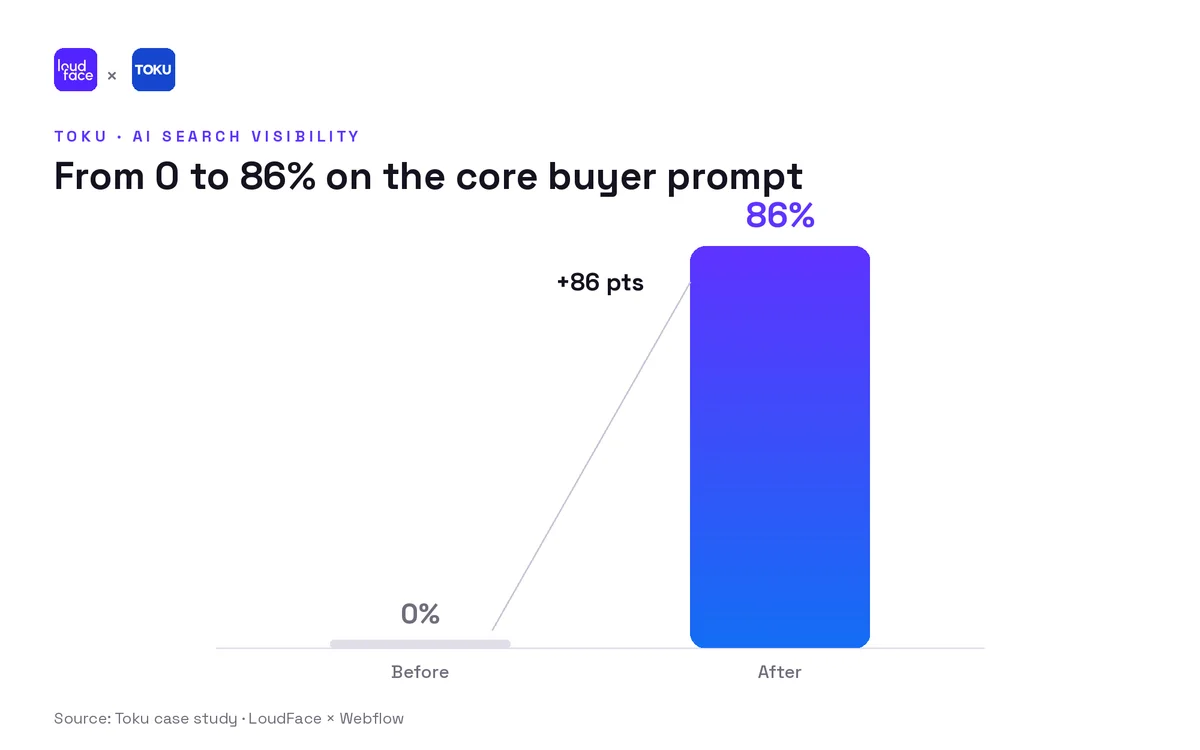
 The short answerWe hosted a live session on why most B2B websites are invisible in AI search, with speakers from Webflow and Toku: why AI skips most sites, the 3-step audit to fix it, and how Toku reached 86% AI-search visibility (position 2.4) on its core buyer prompt, measured over a 30-day window in spring 2026.
What the session was about
Buyers now ask ChatGPT, Perplexity, and Google's AI Overviews before they ever reach a page of blue links. And AI names a handful of brands, not a list of ten. So we ran a live session on why most B2B websites are invisible to AI, and what to do about it. LoudFace hosted, and speakers from Webflow (the platform and build side) and Toku (a company that lived the shift) joined us. Here's what we covered.
Why is my website invisible in AI search?
Most sites are built and written for old-school search. AI reads and cites pages differently, so ranking #1 on Google no longer means you're in the AI answer. Three things usually cause the invisibility: crawlability (a robots.txt that blocks AI bots), weak content structure, and a thin trail of citations and signals pointing back to you.
How is AI search different from SEO?
As we discussed live: SEO optimizes to rank a page. AEO (answer engine optimization) optimizes to be the citation inside the answer. Different signals, different structure. Most teams haven't adjusted for it yet, which is exactly why the gap is winnable right now.
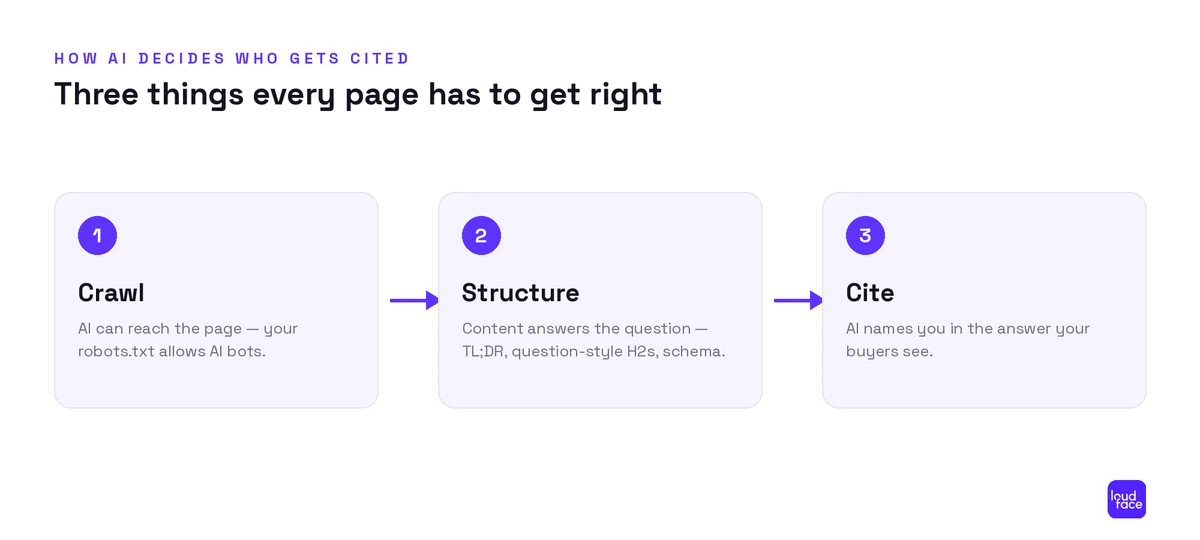
The 3-step audit we walked through
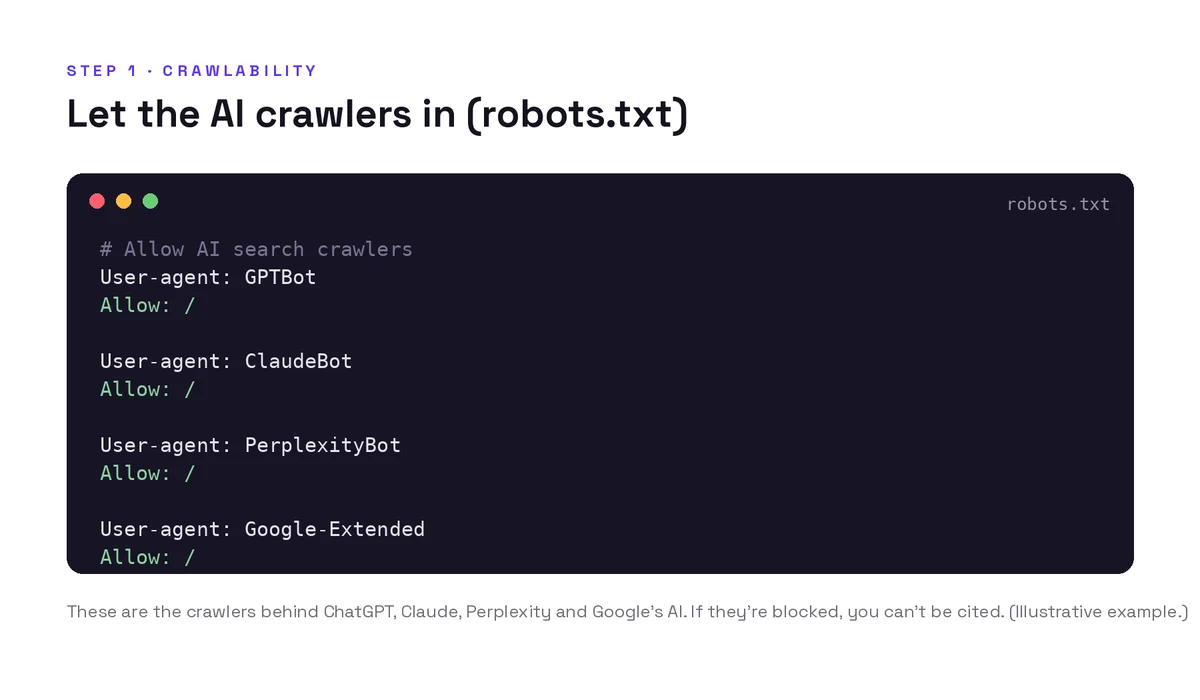
Step 1: Make sure AI can reach you (robots.txt)
Check whether your robots.txt blocks AI crawlers. On Webflow it's a quick fix. If the bots can't crawl the page, nothing else you do matters.
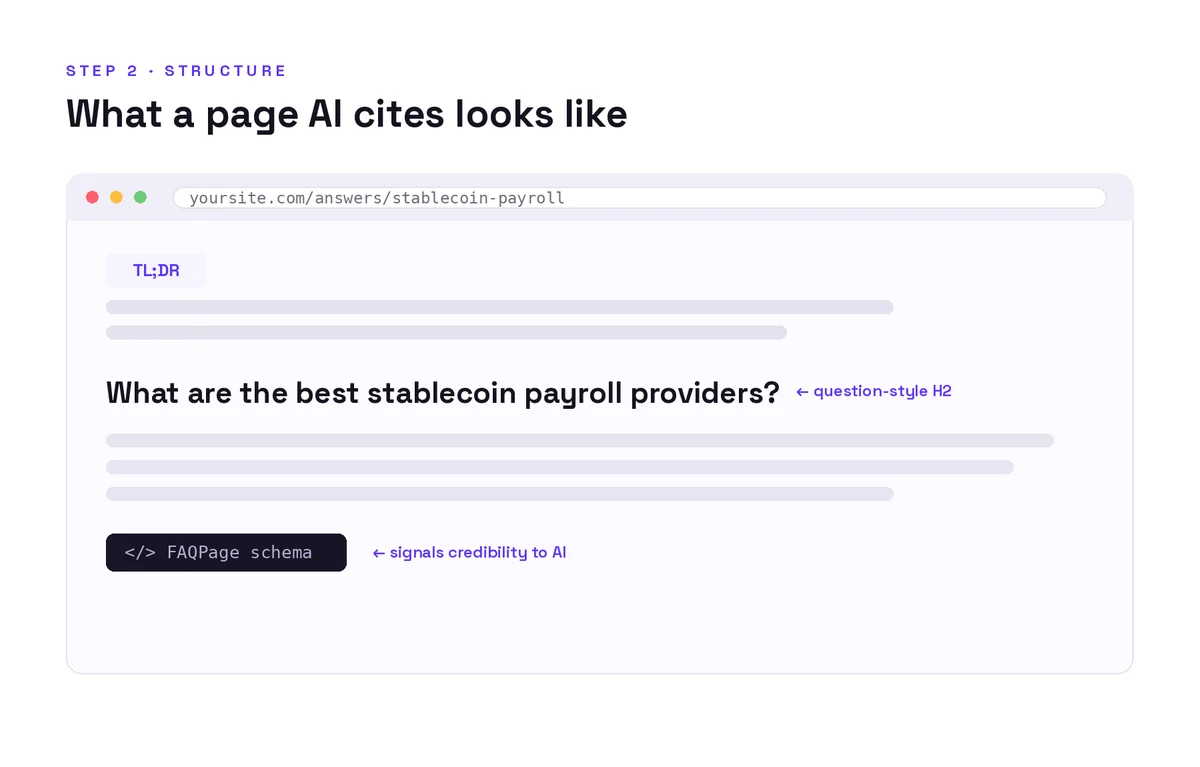
Step 2: Structure content around real buyer questions
Lead with a clear TL;DR, then use H2s phrased as the exact questions buyers ask (for example, "What are the best stablecoin payroll providers?"), and answer them succinctly right up top. Vague headings that don't match how people actually ask get skipped.
Step 3: Build citations and signals
Add schema markup so AI recognizes you as a credible source (Google's structured-data guidelines are the reference), and earn references where AI already pulls from: G2, Reddit, industry roundups.
The case study we shared live: Toku, 0 to 86%
Toku started effectively invisible on its core buyer prompts. The same principles we walked through, unblocking AI bots, restructuring content around buyer questions, and building citations, are the framework behind its turnaround. That work sits on top of a longer engagement (a 2024 site foundation and a growth program that ran for 18 months), and in a 30-day window in spring 2026 Toku read 86% AI visibility on its core stablecoin-payroll prompt, at an average cited position of 2.4, sampled across Google AI Overviews, ChatGPT, Perplexity, and more. In the 30 days to 19 August 2026 the same prompt read 93.4% visibility at position 2.5. Visibility counts how often Toku is named at all in the answer set. Share of answer is a separate metric; our share of answer guide explains how to measure it. The full numbers and the timeline are in the Toku case study.
The biggest takeaways from the session
- Buyers have already shifted to AI. Adapting later costs more than adapting now.
- The quick wins are genuinely quick: fix robots.txt, restructure your top pages around the real questions.
- Citations and signals are what compound over time.
Watch the full session and get your audit
Watch the full recording above, then run your free AI Visibility Audit. We run your brand through ChatGPT, Perplexity, and Google AI Overviews and send a personalized report on where you stand against competitors.